Zithers in Bohemia, Moravia and Silesia
Jan Folprecht, Ostrava 2005
Resume
This publication finally fills the current information vacuum that has existed in our country for more than a hundred years. It is therefore the first publication that familiarizes our musical public with the past and present of the zither in our countries in an informed manner. And I dare say that in this sense it is also a great surprise, because it reveals a surprisingly rich past of both the production and use of these instruments in our country. The fact that the zither has become a completely forgotten and therefore neglected instrument in our country in the last fifty years did not make the author of this monograph an easy task. It was necessary to first introduce the reader to the zither as a completely unique musical instrument and only then to uncover its domestic history. Strangely enough, this reveals a completely different role of this instrument than has been and is still presented in all encyclopedic professional publications within the framework of chordophones. What is published in this book clearly indicates not the episodic and plagiarized occurrence of the zither in our country, but on the contrary, the continuous and independent development of the zither in the Czech lands. And this is a completely new finding for our musical public.
It was also necessary to address the reasons for the aforementioned oblivion. The author uncovered the socio-political background that contributed to the almost complete eradication of the zither from Czech musical instruments during the 20th century. I think that there is no other musical instrument that would have been so unhappily entangled in the national-political upheavals that tore through Europe throughout the twentieth century. Folprecht's great and lasting merit is that he contributed to the preservation of the cultural memory of our nation precisely in this field, where the nation itself voluntarily gave up this heritage after the First World War and strengthened itself in it after the Second World War. It is precisely the exclusion of the national chauvinistic approach to zithers that is the basic form of the author's approach to history that made it possible to gain a new perspective on the past. I am already an eyewitness and therefore I can confirm that at the turn of the 19th and 20th centuries there was a zither in almost every household in our country. Unfortunately, due to the aforementioned social upheavals, zithers have still been preserved in large numbers in our country as family heirlooms from grandparents, but almost no one can play them anymore.
The chapter describing various types of zither is inspiring. In view of the above, the article on Wallachian kobzas, i.e. the folk plucked form of zither in our country, is important. The construction of zithers in the past and present is described in detail. A large space is devoted to tuning methods. Composers who would decide to compose something for this instrument can draw knowledge here. Very interesting reading is about how players used to associate in our country in so-called clubs. This is a social phenomenon that is completely specific to the zither. The documents about what was played on the zither are also very eloquent. This is also related to the musical documentation of compositions by authors who were mainly involved in composing for zithers in the Czech lands. The same applies to Czech zither schools. The number of zither manufacturers in our country, especially in Schönbach, is completely surprising. All this puts the Czech zither into a completely new international context.
Folprecht also devoted considerable space to current events in this area in our country. In this context, I cannot fail to mention with praise the author's permanent exhibition "The Zither in Bohemia, Moravia and Silesia", which has been successfully introducing visitors to Ostrava for several years, essentially the same thing as the content of this book, i.e. the surprisingly rich and unjustly forgotten past of the zither in the Czech lands.
In conclusion, I repeat once again that it is extremely good that this publication is being published. It will certainly contribute not only to preserving the memory of future generations, but also to the spread of zither playing, whether in amateur or concert performance. I believe that after reading this book, interest in zithers will increase and that there will be composers in our country who will try to bring it closer to listeners in a modern form.
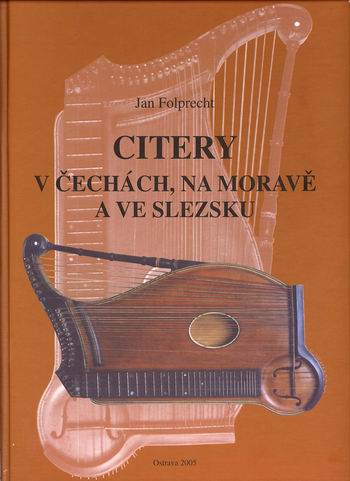
Author: Jan Folprecht
The first monograph about zithers in the Czech language
Publisher: Ostrava Zither Club Radegast, Ostrava 2005


