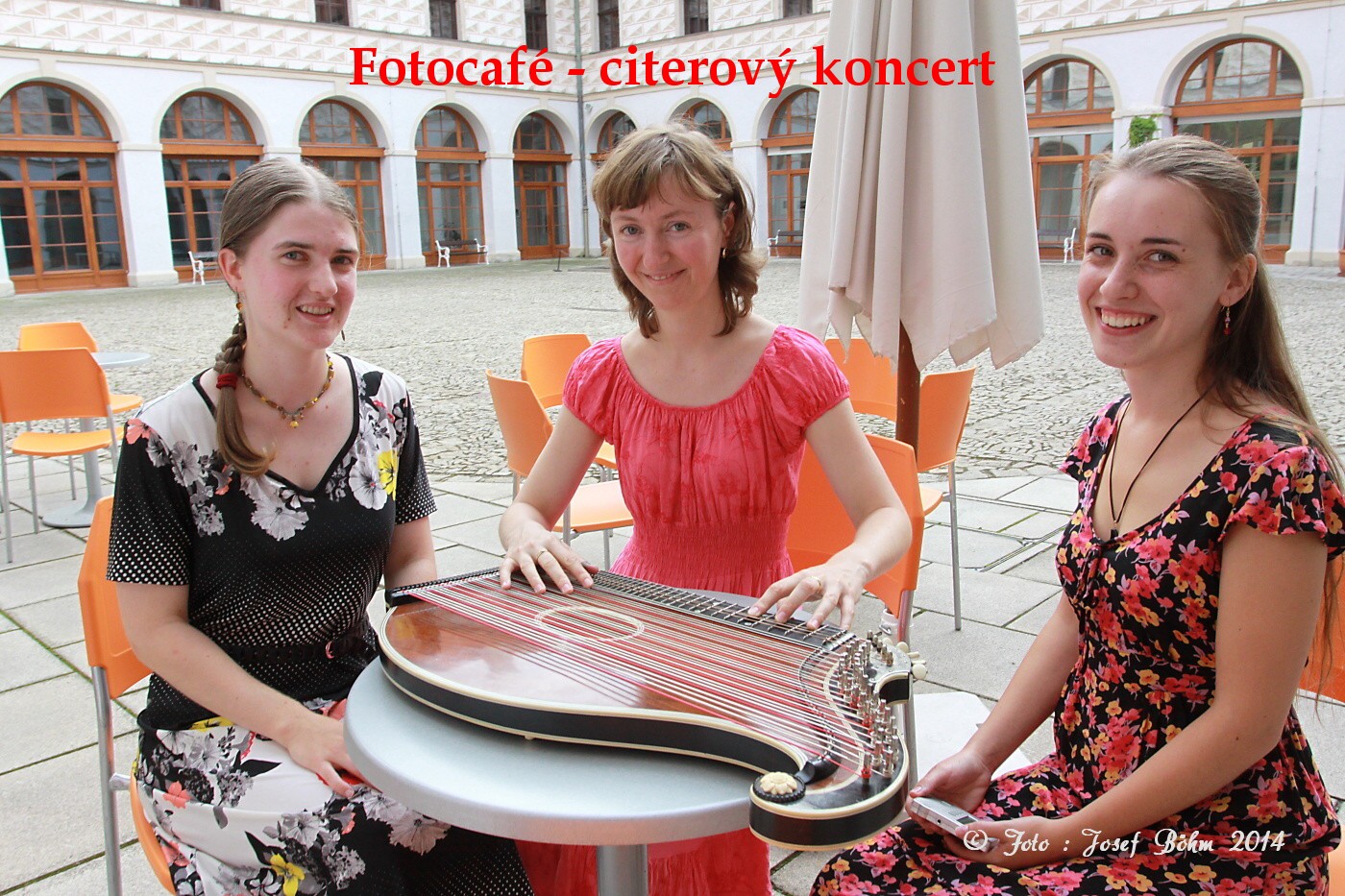
Citrium - women's zither trio
Citrium - women's zither trio
As the name suggests, Citrium is made up of three Czech amateur players: Kateřina Lekšová (born Nováková), Jana Jodlbauer (born Arátorová, but she married during the trio's existence) and Pavlína Pechková (born Cabadajová). Each represents a different part of our republic, Katka Silesia, Jana Moravia and Pavlína Bohemia. In addition to music and a love of zithers, they have one more thing in common: all three are (or rather will soon be) teachers. The group was formed on January 26, 2013, on the occasion of a joint performance, or rather representation, of Czech zither players, in Laakirchen, Austria (near Linz). In German-speaking countries, they perform under the name "Zitrium" so that people can read it better.
Actually, there is one more moment common to all three young girls: in their zither development, or rather maturation, the Ostrava zither player and head of the local Czech zither cultural center – Citerárium, Mr. Jan Folprecht and his wife Eliška, participated in an inconspicuous but nevertheless significant way. For Pavlína (born 1993), who lives the furthest, it was already at the early age of about three years when her mother found a zither in her great-aunt's attic and decided that her daughter had to learn to play it. The Folprechts then came to the Cabadajs in Žirovnica, took some strings, a ring, a key and sheet music with them and introduced the family to playing the zither. But most of all, they recommended the nearest zither player, Mrs. Božena Bartošová from Jindřichův Hradec, for further education. Currently, when Pavlína is studying at the Faculty of Education in Brno, she has to go to Ostrava, or rather to the Beskydy Mountains, where she also got to know her friends a little better during summer seminars for Ostrava zitherists.
Kateřina (born 1991) was also introduced to music by her mother from an early age. She took her first steps with the zither under the guidance of Mrs. Janečková, who lives in Frýdlant nad Ostravicí. When, after two years of simultaneous lessons in oboe at the local elementary school, she started studying this instrument at the Janáček Conservatory in Ostrava, she also began to regularly attend the Ostrava Zither Club, which was led and is led by the aforementioned Mr. Folprecht. The Folprechts immediately recognized her talent for playing the zither, devoted themselves to her and introduced her to the environment of foreign zitherists. This allowed her to quickly improve. By the time she graduated from the conservatory, she was not only the first player in the club, but also the musical director of the ensemble. This is still the case today, when Katka continues her studies at the Faculty of Education of the University of Ostrava.
The third zither player, Jana Jodlbauer (Arátorová, born 1979), comes from Nový Jičín. After graduating from high school, she graduated from the Janáček Conservatory in Ostrava - violin department. She then entered the Faculty of Arts of Masaryk University in Brno, where she studied "musicology and Bohemian studies". During her studies, she met her future husband - an oboist - during a one-year internship in Regensburg. She currently teaches Czech for foreigners at the aforementioned Masaryk University and also at the Brno Technical University. She uses her profession as a violinist, for example, in the ensemble "Campagnuolo barock ansamble", where she plays first violin.
Jana has been playing the zither for the shortest time, just under four years. She became interested when she heard a performance by Mr. Schmidt from Austria, who willingly took her on. All these girls met at a seminar in Kautzen, where the Folprechts were starting to develop contacts between Austrian and Czech zither players. Subsequent occasional visits to the Ostrava zither club helped Jana better overcome the difficulties of the beginning, when at least occasional contact with more experienced players is practically essential.
The trio's repertoire is very diverse. They play various polyphonic compositions, from older music to modern, and they do not shy away from folk songs. They sometimes arrange the notes themselves, and sometimes they use arrangements from the Ostrava Zither Club. Their advantage is that they can also use other instruments that they studied in the previous period - violin, oboe or recorder. Currently, they play more at openings, in school classes, and at Christmas in churches or chapels. The level of their activities is simply due to their mutual remoteness. However, this is not visible in the girls' playing itself.
When it comes to promoting the zither, Pavlína is the most agile, presenting it very systematically, especially in the Pelhřimov and Jindřichův Hradec Králové regions. She also gives the opening remarks at Citrio performances. Like Kateřina, Pavlína also uses the acquaintances and help of the Viennese zither player Wilhelm Neubauer, whom she met through the Folprechts. For years now, she has been traveling to Kautzen, Austria, every year for the international zither seminar there. In short, zither players are one family throughout Central Europe, and young people everywhere find the door to older and more experienced zither players open.
I think it is now clear why the author dedicated this collection to the members of Citria.
In Ostrava on 26.3.2015 Jan Folprecht