Some advice for beginning zither players
Jan Folprecht 2002
A Allow me to introduce myself.
I am like a map of a small fairyland,
anyone with imagination can also see a woman in me,
a gracefully lying, shaped body.
If you want your hand to resonate
with beautiful, soothing tones,
you must caress it, tenderly, with feeling and love for it,
then your reward will be music like from paradise.
Do you want to address me intimately
and do you want to have sex with me?
If your love for me is great,
you can call me ZITHER .
František Navrat
Čeladná 15.4.2000
Introduction
Around the turn of the 19th and 20th centuries, zithers were widespread in Bohemia and Moravia about as much as guitars are today, i.e. they were found in almost every household. At the end of the last century, numerous zither clubs were established in Bohemia and Moravia (there were over 10 in Prague alone) and Czech zither music was cultivated in them as part of social life. The “First Prague Cither Club” was established in Prague as one of the first in Europe in 1875. Since 1891, there has been a professional magazine “Český citerista”, which was published in Prague. In Bohemia, there were not only many excellent zither composers, but also players and teachers.
We don't know much about it today - it has fallen into oblivion. In addition, zithers in our country paid the price for the simplistic idea that, since the end of World War I, began to closely associate the zither with the German ethnic group. Rejecting everything Austrian, we also rejected the zither. We did so even more consistently after World War II, because the German ethnic group in the border region naturally continued to play zithers and so zithers became, to put it simply, one of the symbols of German expansionism and superiority. As a result, zithers in Bohemia and Moravia almost fell into oblivion.
Nevertheless, playing the zither did not disappear in our country even in the second half of the 20th century. Stanislav Kofroň from Příbram's attempt to map and revive playing the zither was unexpectedly successful in 1984 and caused a great response and activity among about a hundred active players in Bohemia and Moravia. The Prague Cither Players Club was founded again in Prague, later the RADEGAST Cither Club in Ostrava, and for ten years in a row Czech zither players met at their regular meetings. The last major event of Czech zither players was the organization of the 1st International Congress of Cither Players in 1998 in Rožnov pod Radhoštěm, where 150 participants from all over the world gathered.
It is clear that the instrument could not be held responsible for the national and political hardships that tore through Europe in the 20th century. It is also becoming clear today that much of the zither history took place in Bohemia in the past, which we can proudly claim and which can be successfully built on. The rich Czech past of zither production and zither playing was demonstrated by the exhibition "Zither in Bohemia", organized by the Cheb Museum in 1988 in Cheb and later similar exhibitions in Frýdek-Místek and Havířov and in 1997 in Prague at Hradčany, up to the current permanent exhibition in Ostrava (all organized by Jan Folprecht).
The future of playing the zither, this truly relaxing music, does not have to be pessimistic if we find the path that it took more than twenty years ago in Bavaria. Today, thanks to systematic care, thousands of young people there are dedicated to playing the zither and with great self-confidence and pleasure they master it in a modern sense. Not only is the national cultural wealth preserved, but it is also developed at the same time.
Almost all musical genres and styles can be played on the zither. The best example of this statement is Michal Müller from Varnsdorf, a recent graduate of the Vienna Conservatory, who is starting to significantly contribute to the progression of zither playing in Europe. However, I believe that the zither is primarily an instrument for home music making, as it is suitable as a solo instrument and as an accompaniment, for singing or for interplay with other instruments. It is not a noisy instrument and playing it, or rather listening to it, evokes pleasant and calming emotions.
It is said that the guitar has a melodious tone. It is said of the zither that its tone is captivating. Whoever is captivated by the tone of the zither will forever fall under its spell.
I have compiled the few pieces of advice listed below for those who are starting out today or are interested in learning something about the zither. Interested parties can only draw information from old schools of the game from second-hand books and inaccurate encyclopedic books. However, these schools are already outdated in many ways and, most importantly, they take into account the role of the teacher. There used to be enough quality and qualified teachers of the game - today the situation is different. A beginner often does not have the opportunity to hear or see the zither played, let alone find a teacher. Therefore, for self-taught players, the old schools in question are completely inadequate.
Encyclopedic information about zithers suffers from many inaccuracies. Unfortunately, half-truths and once-rooted errors are repeatedly described and published in new, and unfortunately reputable, publications. The way the zither is perceived today was aptly captured by Ilja Hurník in the poem "Zithera" from the collection Neveselé žalozpěvy.
Zither
The zither polished its strings
until they shone golden and went to
sign up for the orchestra.
"This is what a critic wrote about me",
she said confidently,
throwing out a clipping that read:
Whoever knows how to play golden strings,
honor him more than yourself.
"We are sorry," they told her,
"everyone hererespects themselves
so much that they can no longer
respect anyone more than themselves."
Zitera turned and left in annoyance.
She doesn't play in the orchestra.
What follows is not a comprehensive theory of playing or a school of playing for beginners. It is really just a collection of some advice and knowledge that could make it easier to get acquainted with the instrument and help to fix some correct basic habits. The presented text was compiled on the basis of my own personal experience and on the basis of modern schools of playing the zither (in German) by Simon Schneider and Richard Grünwald.
Jan Folprecht
Getting to know the tool
About the zither
Without claiming to have a patent on the only possible and correct description of the zither, I would like to contribute to ensuring that in five, ten or fifty years there will still be no professional literature reflecting the views of the late 19th century. I therefore offer the following encyclopedic description of the zither:
The zither is a multi-stringed plucked instrument with a flat body. It is placed on a table and played while sitting.
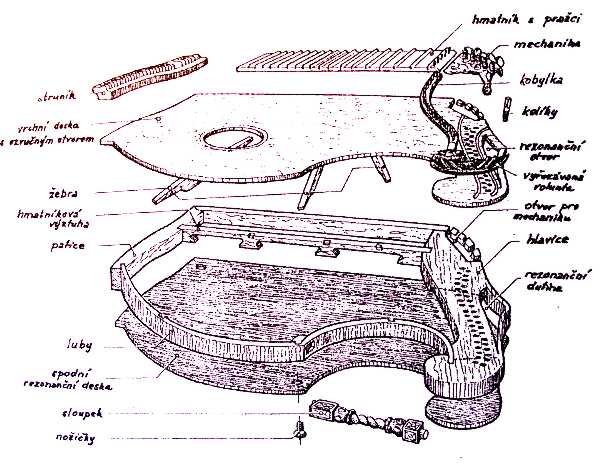
The body of the zither (see Fig. 1) consists of a top plate with a sound hole (one or more), a lower resonant plate, a headstock with a mechanism (for tensioning the melody strings) and pins (for tensioning the free accompanying strings using a key) and an opposing tailpiece equipped with a fret. The top and bottom plates are connected around the circumference by edges and the entire surface is veneered. The inside of the body is reinforced with several ribs, which serve to strengthen it, since the tension of the strings is considerable. A fingerboard with chromatically arranged metal frets is attached to the top plate along the edge. The opposite edge of the body is usually cut out in an S-shape. The bottom of the zither is equipped with three legs with metal spikes. The legs serve to transfer resonance to the table top (to amplify the sound) and the spikes ensure a stable position (so that the zither does not slide on the table).
The soundboards are usually made of spruce, the sides and veneers of the boards are usually made of maple or rosewood. The fingerboard is usually made of ebony.
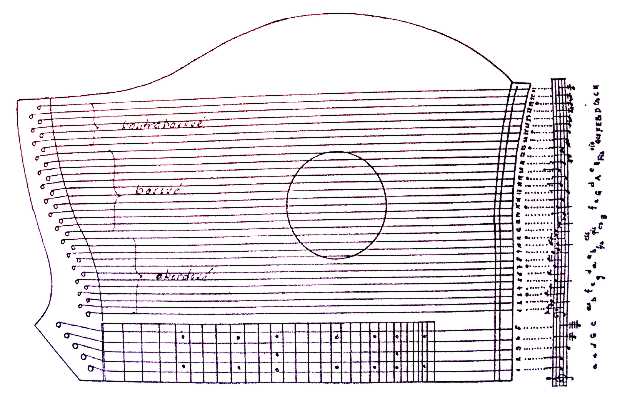
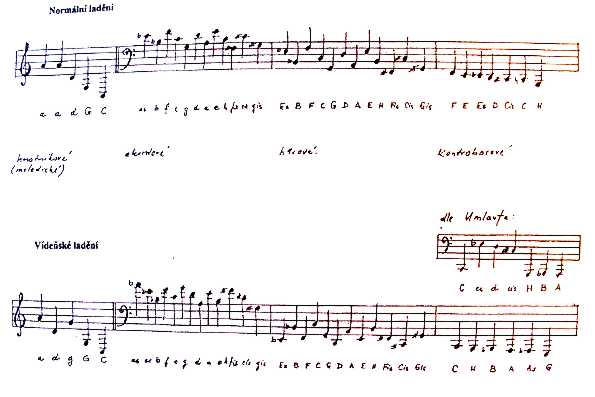
Stringing: The strings are tensioned parallel to the upper soundboard and are of two types: Above the fingerboard with frets there are five melody strings and further (parallel to them) there are free accompanying strings (chord, bass and double bass), of which there are usually 27 to 37 (depending on the equipment with double bass strings). The normal tuning of the melody strings is shown in Fig. 4. In our country, the so-called Viennese tuning is also common, shown in the same picture.
The tuning of the accompanying strings is the so-called quarto-fifth, i.e. the tuning of the neighboring strings decreases in the interval of a fourth, which, however, is interrupted after two or three intervals by an octave rise (practically by a fifth), and thus all the notes of the range are alternated in the accompaniment. The practical significance of this tuning (see Fig. 2.), which was introduced by Nikolas Weigl in 1838, lies in the stable form of the frets of the accompanying fifth chords and in the mutual adjacency of the basic chords of the respective key.
The way of playing is that the ring finger on the thumb of the right hand is used to pluck the melody on the fretboard (melodic) strings, controlled by the fingers of the left hand, and the other fingers of the right hand are used to simultaneously play the accompaniment (using various combinations of strokes of the accompanying strings).
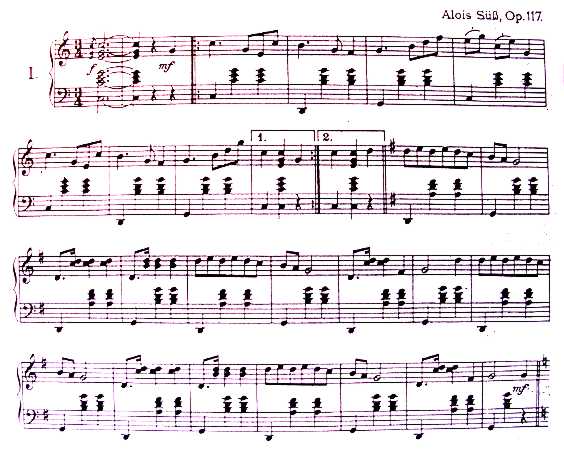
Sheet music for the zither is written (as with the piano) in two staves - in treble clef for the melodic notes and in bass clef for the accompanying notes.
History of the development and production of the zither: The predecessor of the zither, as we know it over the past 150 years, were folk musical instruments called in the Alpine regions šajtholt, in Sweden hummel, in Norway langleik, in Denmark langspil and in our countries kobza. Instruments similar to the kobza (šajtholt) have been used since time immemorial and are still used today all over the world, from East Asia to Africa.
At the beginning of the 19th century, in areas where the sajtholt was used, these old plucked zithers were transformed into plucked multi-stringed instruments. Weigel's principle of stringing laid the foundation for the modern zither. The leading places in terms of development, production and use of zithers were Vienna and Munich. A famous player was Johann Petzmayer (1803 - 1884), a court virtuoso of Prince Maximilian of Bavaria.
The first types of zithers, which differed in shape, were called by their place of origin: the Salzburg and Mittenwald forms. The beginnings of zither production in Munich are associated with the names: Franz Kren, Ignaz Simon and Georg Tiefenbrunner. The founder of mass production of quality zithers was Anton Kiendl in Vienna and Mathias Amberger in Munich. By the end of the 19th century, there were dozens of excellent manufacturers in Europe.
The Czech lands were not left behind in the development and production of zithers, which is evidenced not only by the preserved instruments of Antonín Mitáš from Litoměřice and Bernard Berkmajer from Jihlava (from the early 19th century), but also by the later production in the Ore Mountains - represented in particular by Antonín Bräuer from Luby (Schönbach). One of the first documented zither players in our country was František Dvořák, the father of the composer Antonín Dvořák. The great Czech pioneers of playing the zither were the brothers Karel and František Cibulové. They published a large number of their own compositions and transcriptions, as well as several schools of playing.
Contemporary top production in Europe is represented by the names Adolf Meinel and Horst Wünsche from Markneukirchen and Ernst Volkmann in Ingolstadt.
The division of zithers has settled into four size categories and several shapes. The basic type is treble zithers, whose first fretboard string is tuned to "chamber A" and the scale of the fretboard strings is 410 to 430 mm.
The so-called fifth zithers are tuned a fifth higher, and have a scale length of approximately 390 mm.
Alto (elegic) zithers are tuned a fourth lower than treble zithers, with a scale length of 505-510 mm.
Bass zithers are tuned an octave lower and have a scale length of approximately 570 mm.
Common treble zithers, which are by far the most widespread, tend to have 27 to 29 accompanying strings. Those with more are called concert zithers, and the top type of concert zithers are the so-called harp zithers, which tend to have about 37 accompanying strings, a scale length of up to 440 mm, and are primarily characterized by a decorative post that reinforces the cutout of the body (see Fig. 1).
The current progressive design of the zither is E. Volkmann's instruments, built in the psaltery form, i.e. with a trapezoidal body and three sound holes with rosettes.
Today, the zither is no longer as closely or as intensely tied to Central Europe as it was at the end of the 19th century. It is spread, albeit sparingly, throughout the world, and is particularly popular in Japan and the USA.
Kinds and types of zithers
Now a little more detail about some aspects of the zither and playing it:
Zithers are no longer made in our country. However, there are thousands of those that still exist, and it can be said that almost every one is a little different. They differ in shape, construction and size of the body and its parts, the material used and external finish, the number of strings and scale (i.e. the length of the fretboard strings), which is all of course related to different manufacturers. The number of strings and scale determine the basic type of normal zithers. In addition to normal zithers, there are also reformed zithers (the bass strings are tensioned in two planes, i.e. over the upper and lower bridges) and Perfect zithers (the accompaniment strings are tuned in a triple circle of fifths, with the strings of the third circle placed transversely over the strings of the second circle so that the little finger can control them well).
As already mentioned, all normal zithers whose first fretboard string is tuned to "chamber A" are called treble zithers. Their scale length is from 410 to 430 mm.
The so-called fifth zithers (short) are tuned a fifth higher and have a scale length of approximately 390 mm.
Alto (elegiac) zithers are tuned a fourth lower than treble zithers, and have a scale length of 505 to 510 mm.
Bass zithers with a scale length of approximately 570 mm are tuned a fourth lower than treble zithers (these are the only ones that are almost non-existent in our country).
Treble zithers are often called concert zithers (they usually have 36 to 38 strings), regular treble zithers usually have 32 to 34 strings, and the top type is the harp zither (they usually have 42 strings and a scale length of 440 mm).
In addition to fingerboard zithers, there are various others that do not have a fingerboard. These are the so-called chord zithers (with strings tuned to chords and others tuned chromatically) or the so-called manual zithers (chords on chromatically tuned strings are played using manuals). Our guide does not cover these types, as they are played completely differently and do not provide nearly the same possibilities of musical expression as classic fingerboard zithers.
Modern zithers have a tailpiece bent according to the drawing of the harp zither, as this allows the bass strings to be plucked further from the edge, i.e. softer. They also tend to have one more resonance hole in the head of the instrument (see drawing of the harp zither body).
As for the quality of the instrument, for starters, no virtuoso can make even the best instrument. You can play whatever you can find. There are still plenty of them left over from our ancestors in the attics. In Prague, there are always at least a few zithers for sale in the musical instrument bazaar. The main thing is that the zither is not cracked or unglued somewhere, that it is not deformed and does not have a bent or otherwise crooked fingerboard, and that it holds its strings (does not rotate when the strings are tensioned) and the mechanics work.
However, it should be borne in mind that modern zithers make playing much easier and better, so there is no point in saving on the investment in an instrument. As your playing skills improve, you will still want to get a better and better instrument. A quality instrument increases the satisfaction of playing and encourages the player to be more inventive in his playing.
Since there are no zither manufacturers in our country, there are no repairers of these instruments either. Repairs can be requested at regular musical instrument repair shops, or at violin or guitar makers (the current offer is Mr. Hanzík in Příbram, see the address on the last page). If it is not a rare instrument (which is usually the case), then it is best to get another zither, because the price of another old zither is equal to the price of repair.
Accessories
A storage case is an essential accessory for a zither , which allows it to be safely transported and protects it from dust and weather conditions (especially temperature changes, as this leads to the instrument being out of tune). Many people have recently replaced their old wooden cases with new textile cases lined with foam. The case has space for a tuning key, a ring, spare strings and possibly a brush or velvet duster . The duster is flat so that it can be used to wipe away dust under the strings. It is equipped with a brush at one end for cleaning the fingerboard and hard-to-reach places around the pegs.
To play from sheet music, you need a table music stand . It can be of various designs. There are no limits to your own initiative here.
A necessary accessory for playing the zither is a suitable table underneath it. It is called a resonance table because it is usually made of resonant wood, which helps the sound from the zither to spread through its resonance. It also has a folding structure to make it easier to transport. It must be sturdy and its top should be 65-70 cm from the floor. The table for the zither should be lower than normal dining tables. This is so that the arms form a roughly right angle with the forearms of both hands. If we are forced to play on a table that is normally high, we need to adjust our posture with a pillow, or use a swivel piano seat.
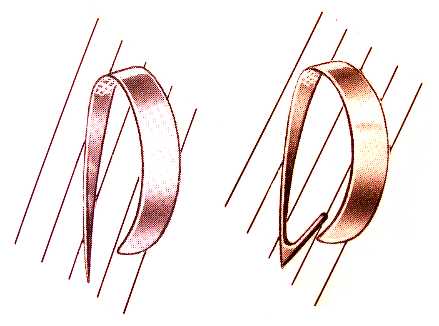
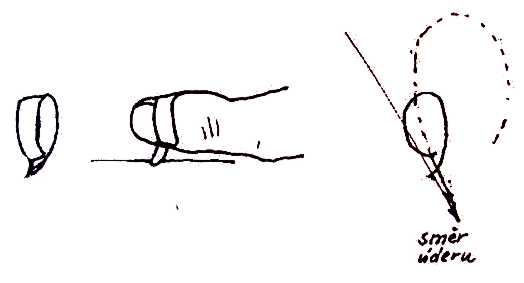
A ring is put on the thumb of the right hand , which vibrates the strings above the fingerboard. They are made in various sizes - but they are not sold in our country. If one of the zither players does not give you one, you will have to go to Germany or Austria with it. Steel rings, which are widely used, are relatively hard and give a sharp tone. Rings made of copper alloys (pakfong, brass) create a softer tone. The beak of the ring should not be long or short, it should point forward and should be partially bent, because the correct blow is made diagonally downwards (see Fig. 3). To make the ring hold well, a small piece of adhesive tape is sometimes stuck to the end of the thumb and the ring is put on over it (see Fig. 3). Rings cast from various metal alloys can be obtained abroad. They are relatively narrow and therefore depend on the correct choice of size and shape. The current hit is the blowback ring, which allows for faster strumming.
Strings
As for strings, this is perhaps the biggest pain of Czech zither players, because for a long time no strings could be found in our country. What is played in our country has little in common with good strings.
First of all, it is necessary to adhere to the principle that the appropriate string must be in the appropriate place. Every string on the zither is different. If we use a replacement string of a different thickness, we will make a mistake, because we will then have to tension it more or less than the correct string, which results in the string being too stiff or too stiff, which both makes playing difficult and also makes the string sound bad.
Another common mistake is that zithers are often out of tune (supposedly to prevent cracking). Such strings do not tune well and the sound of the zither is weak and unclear. In short, the strings are designed for the correct assumed "pneumatic".
Quality strings make playing much easier and better, so there is no point in saving on strings. Just like a quality instrument, quality strings increase the satisfaction of playing and encourage everyone to be more imaginative when playing. Modern nylon strings do not hurt your fingers as much. The new strings also have distinctive red markings and improve orientation in the strings.
Some strings on the zither are plain, some (and most of them are) are braided. In the past, plain strings were made of steel or gut, today they are either steel or nylon. Braided strings have either a steel or nylon core. The braiding can also be metal or nylon. Most companies produce both types. Very good strings are from the brands: Pyramid, Bergfee, Fisoma or Lentzner .
Metal strings have a clear, sharp tone and can be picked up by an electromagnetic sensor, nylon strings are picked up only by an acoustic sensor. Nylon strings have a softer and smoother tone, but they are more susceptible to temperature changes, are more likely to go out of tune and have a shorter lifespan (but they have a more pleasant sound and your fingers do not suffer as much). When you first string them, you need to allow for some time for them to "come down", meaning that they must be tuned frequently before they settle.
When buying strings in Germany or Austria, a salesperson may surprise you by asking what tuning the strings should be in. The following article is about tuning. Let's just say that if you want strings for normal tuning, it is sometimes necessary to use the word "Munich" as a synonym.
The metal pins in the zither headstock have a very fine left-handed thread. By turning them to the left, we slowly screw them into the pin holes, and by turning them to the right, we do the opposite. We wind the strings onto them so that the thread of the strings does not overlap and that the string is wound mainly in the lower part of the pin. The pin must be screwed in deep enough (so that it does not wobble), but not too much (so that the counter-thread in the wood does not tear). Winding the strings therefore requires experience, because in order to wind the string, the pin must first be unscrewed to the optimal position by as many turns as the string will then be wound onto it. If a pin is loose (has a stripped thread), it can sometimes be helped by gluing it in so that it can hold the string tension again, but it is better to create an insert in the hole made of thin wooden foil.
Before we start playing
Tuning
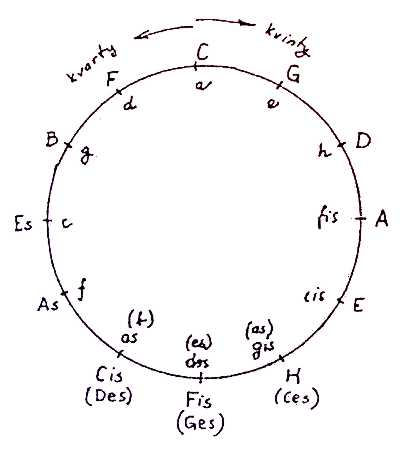
The tuning of the chord and bass strings is according to the fourth-fifth circle (see Fig. 5), i.e. from the fingerboard gradually down by fourths, with the third or fourth string again being an octave higher (a fifth compared to the previous one) and then again down by fourths (see Fig. 2). The double bass strings are tuned chromatically. To facilitate orientation in the accompanying strings, every fourth is red (f, a, cis, F, A, cis, F´, cis´).
Tuning chord and bass strings according to the fourth-fifth circle has the basic advantage that any tonic chord (e.g. strings no. 3,4,7 – F major) has the corresponding subdominant chord played with the same fingering next to it, closer to the fretboard (in this case strings no. 2,3,6 – B major), and on the opposite side of the adjacent strings from the tonic, the dominant chord can be played with the same fingering (in this case strings no. 4,5,8 – C major). The basic chords of any key are therefore nicely together and can be alternated relatively easily.
Chord accompaniment is created by striking the corresponding bass string with the ring finger of the right hand and striking one string with the middle finger and two with the index finger. simultaneously or staggered for major chords (or two strings with the middle finger and one string with the index finger for minor chords). For seventh chords, only a double note is played with simultaneous unison to the bass root.
Even before you start learning to play, you have to decide which tuning to use. In the course of the historical development of the zither and its playing, two tuning systems developed in the 19th century – the Viennese and the Munich. The author of the Munich tuning was Mikoláš Weigel, while Karel Umlauf is credited as the author of the Vienna tuning (he introduced the so-called “Styrian G” on the fretboard). The Munich tuning was slightly modified by Max Arnold in 1878 and has since been called the normal tuning (see Fig. 4 for the differences).
The whole world plays in normal tuning, only in a few places in Austria, Slovenia and Bohemia does the Viennese tuning persist. The situation is perhaps only complicated in our country, because we are on the border of both areas. Given the historical context, it is understandable that we played mainly in Viennese tuning (this does not apply to the Sudetenland region) and therefore most of the elders who could teach you or at least give you advice play in it. However, new schools in this tuning probably no longer exist. Of the new schools for normal tuning, there is the school of Simon Schneider and the school of Richard Grünwald "Meine Methode". In 1988 and 1989, the first two volumes of the new Czech school for normal tuning by Čeňek Brožovský were published in our country.
There is no point in asking which tuning is better. Each has its advantages and disadvantages. Viennese is suitable for chordal playing on the fretboard (the style of Styrian folk songs), normal better meets the requirements of modern music (easier orientation on the fretboard. If it were not for the preservation of the state of development of the zither in our country, which occurred with the collapse of the Austro-Hungarian monarchy, we would probably not be concerned with the above-mentioned dualism. The fact is that new notes are published almost only in normal tuning. That is why all beginner students in our country learn to play in normal tuning.
The actual procedure for tuning the strings should be carried out by first tuning the fretboard strings and then the accompaniment strings accordingly. This is a lengthy procedure and requires a lot of hearing. It is therefore not surprising that a humorous slander has arisen about zither players, according to which they spend half their lives tuning and the other half playing on an out-of-tune zither. After the first tuning, the strings must be checked (fine-tuned), because the body is working during tuning (the tension of the strings is very significant).
Electronic tuners are an excellent tool for tuning. If we want to play in an ensemble of several zithers, then the use of an electronic tuner is almost essential. If they are supplemented with a suction microphone, it is possible to tune even in a noisy room.
How to do it
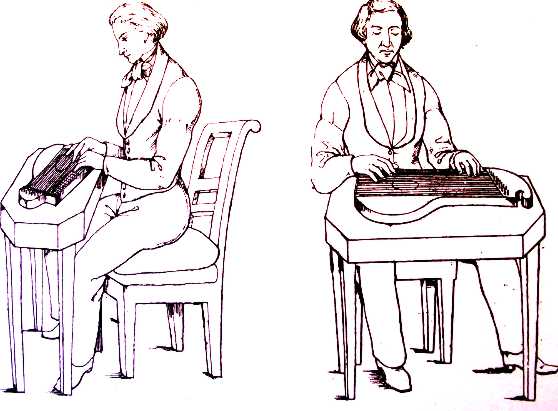
The zither is placed on the table at a slight angle (see Fig. 6). The axis of the player's body sitting at the table should be to the right of the axis of the sound hole (roughly halfway between the sound hole and the tailpiece).
The player sits relaxed, upright, slightly leaning forward (so that the chin is about above the edge of the table). The legs are slightly apart and the feet are resting on the ground.
Right hand position and playing
Right hand position and playing
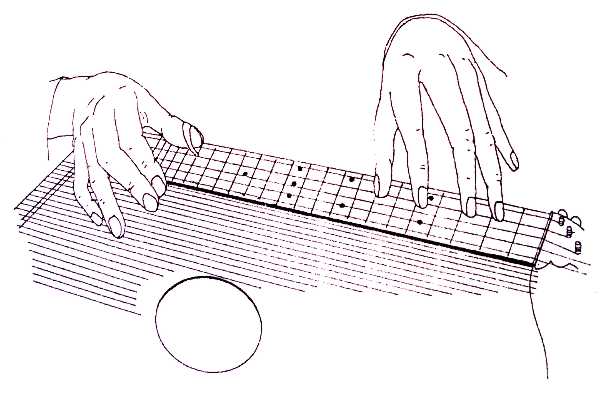
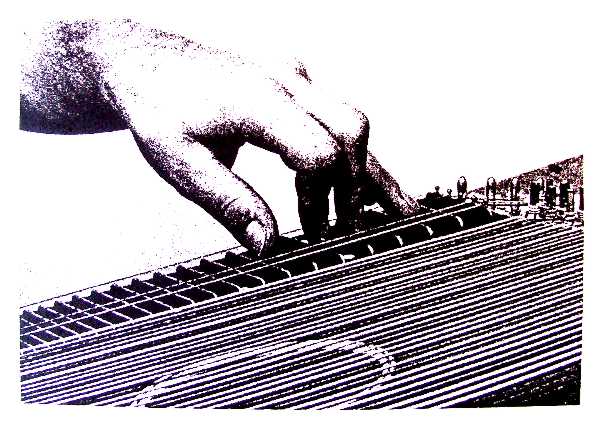
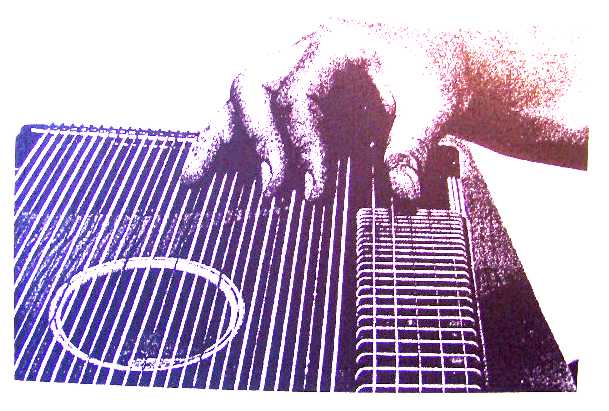
The outer edge of the palm of the right hand must rest on the tailpiece at the fretboard strings. The position of the fingers and the entire hand is shown in Fig. 7. The tips of the fingers should lie on an imaginary straight line. The highest point on the back of the hand is the joint of the index finger.
The basic hand position can be practiced, for example, by resting the index finger on the 4th string, the middle finger on the 7th accompaniment string, and the ring finger on the 15th bass string. The finger strike is performed downwards. The fingers never lift after the strike, but remain lying on the other strings, onto which they slide with the strike (they must always rest on the strings).
Note: Each basic major accompaniment chord is always formed by the corresponding bass note and a triad played in such a way that the middle finger strums one string (e.g. No. 7) and the index finger strums across two adjacent strings (e.g. 3 and 4 – i.e. it will then rest on the fifth string). Minor chords are played the opposite way, i.e. with the middle finger across two strings and the index finger across only one. Simultaneous consonances of seventh chords are formed by a doublet to the bass fundamental note. In general, accompaniment chords can be played harmonically (simultaneously) or melodically (separately).
To develop the right hand, I recommend that beginners first leave their little finger on the string and practice "napnelism" between the thumb resting on the fingerboard strings with the ring finger and between the index and ring fingers resting on the accompanying strings. Then, to practice independent accompaniment, it is necessary to practice alternating and harmonious strokes of the thumb and index or ring finger. Once you manage to play a piece of melody on the fingerboard in such a rhythm, the foundation for practicing accompanying play is laid.
The little finger can lie freely on the strings while playing (i.e. it does not rest on the tailpiece, as was prescribed in the old schools). However, it is best if it rests on the string, on which the ring finger playing the bass then slides after the stroke (in this case, string no. 14). This is because the little finger helps the ring finger to press the adjacent string towards the fingerboard, i.e. it makes it easier for the string no. 15, which is vibrated by the stroke, not to touch the ring finger and therefore not to strum. It is also possible to play the little finger simultaneously with the ring finger. The little finger is also used to play the double bass (this is learned later). In order to reach it, the index finger usually has to be raised, but the middle and ring fingers must still maintain their position on the strings, in order to fix the back position of the hand.
The thumb of the right hand always rests with its ring finger on one of the fretboard strings. After striking, it rests on the string on which it slid. The strike with the thumb is performed in a circular downward motion.
It is important to make sure that all fingers of the right hand are resting on the strings and that they are moved to strike only just before the stroke. This is the most common mistake of beginners, and if it were to become fixed, it would not only accompany you all the time, but would also make it difficult for you to further develop your right-hand playing technique.
Left hand position and playing
The forearm of the left hand should be horizontal up to the fingers, which should be bent at the joints and placed vertically down on the strings, just behind the frets. This does not apply to the thumb, which should be placed on the outside of the fingernail. The strings are pressed with the tips of the fingers, closer to the fingernails.
It is important that all fingers must lie on the fretboard as much as possible at all times. This is generally the same (and equally important) rule as for the right hand. For example, if we want to play the note "a" on the D string, we do not press it with our thumb only on the 7th fret, but at the same time we lightly place our ring finger on the 2nd fret, our middle finger on the 3rd fret, and our index finger (more firmly) on the 5th fret (see Fig. 8). This basic position must be carefully practiced even when the melody changes to the adjacent strings and, most importantly, adhered to.
To shape the left hand, beginners are advised to place their fingers on the fretboard as described in the second paragraph (see Fig. 8) and then watch TV, for example. However, check occasionally to make sure that the fingers have not slipped elsewhere and are still lying close to the frets.
The most common double notes on the fretboard are thirds and sixths. Triads (chords) and fifths can also be played on the fretboard strings, which create a fuller sound for the instrument. The thumb strike must be performed so that the notes are in unison (unless the opposite is intended).
Finger exercises
Finally, it is important to note the need to exercise your fingers before playing. Here are some possible exercises that are suitable for this purpose:
- opening and closing the fists of the hands
- clasp your hands and stretch your fingers by opening them together and individually (slowly)
- place your hands palms down on the table and slowly lift individual fingers and their combinations
- pulling tense fingers apart (swaying)
- Crossing adjacent fingers over each other (resting)
- Gradually touch the tips of the thumb with the other fingers and apply pressure.
The practice should also include exercises for the whole hands, such as raising and slowly lowering the hands in front of you with the transfer of feeling to the fingertips. It is advisable to perform such exercises with pauses for relaxation and shaking the hands. about 10 minutes.
It is essential to wash your hands thoroughly before playing, as oily fingers make it much harder to produce notes. Before starting to play, it is always necessary to check the correct position of the zither, body and hands.
Sheet music
A prerequisite for playing the zither is the ability to read music, i.e. knowledge of the basics of music theory.
Sheet music for the zither is written in two staves, with the notes played on the fretboard written in the upper staves in G-clef (violin) and the accompanying notes in the lower staves in F-clef (bass). There is a fair amount of old sheet music – the Ostrava Zither Club RADEGAST archives over 3,500 parts of compositions and arrangements for zithers. Contemporary new literature is not available in our country – it can be obtained from the Ostrava Zither Club, or preferably directly from abroad (Bavaria, Austria), where there is plenty to buy in all musical genres.
Beginners at the Radegast zither club successfully learn to play the zither according to the modern school of playing by Čeněk Brožovský. Although it exists only in xerographic copies (and only the first two volumes have been published), it is very suitable for acquiring the right habits, as it is based on Czech folk songs and elements of Renaissance music.
Right hand position and playing
In order to master the basics of playing the zither, you need to gain strong motivation. Playing the zither is quite difficult and the habits of flawless playing are acquired very slowly. Therefore, it is necessary to set yourself gradual small goals. You will be happy to achieve them and it will give you self-confidence and a desire to continue learning.
When practicing correct hand placement, a mirror placed in front of the instrument on a table instead of music is an excellent aid, as it allows you to easily observe and check the position of your hands while playing.
Try to get and listen to various recordings of zither music and especially try to contact another zither player. You can listen to and learn much more from an experienced player than you can describe in words.
From the beginning of the game, pay attention to the purity of the tones, i.e. that the strings do not strum and that they resonate properly. For practice, look for various simple and melodic pieces that will interest you with their appeal.
Don't ignore sore fingers at first. After a short time, the tips of your fingers will harden and stop hurting. However, you need to exercise regularly so that the calluses on your fingers don't disappear again.
I wish you much success!
P.S.
Advice and help can be sought at the Ostrava Zither Club RADEGAST Masarykovo nám. 20, Ostrava 1, 701 00, tel./fax.: 59 611 30 96 or at the Prague Zither Players Club (Anna Bašová, Doublebská 8, Prague 4, 140 00, tel. 723 213 202) and especially at the only graduated zither teacher, Michal Müller, P.Bezruče 3155, 407 47 Varnsdorf.
V. revised edition
2011


