History of the zither in Bohemia, Moravia and Silesia
History of the zither in Bohemia, Moravia and Silesia
Jan Folprecht
Introduction
What comes to mind when people think of the term zither today? I would say that only a few people in our country know the zither today, and in that case they usually attribute it to the German ethnic group. For most people, the idea of the zither comes from the incomprehensible number of strings and the archaic shape that gives the impression of antiquity. Many people have no idea about the zither. A permanent exhibition of zithers has been created for all three groups of people at Masarykovo náměstí 20 in Ostrava.
The purpose of the exhibition is to commemorate this forgotten instrument in our country and to show, against the background of the historical development of the zither, the rich tradition of both production and use of these instruments in Bohemia, Moravia and Silesia. The aim is also to draw attention to the fact that playing the zither has not yet disappeared in our country and is still developing.
The set of exhibits on display was compiled from the collections of Jan and Eliška Folprecht. Many interesting documents from the history of Prague zither clubs were provided by the well-known local zither player Jiří Moravec.
How many zithers still lie forgotten in our attics today! Some also serve as decorations on the walls of cottages or huts. And yet it was not so long ago that the zither was spread just as the guitar is spread today. However, as quickly, even precipitously, it spread, so quickly did interest in it decline. Zithers can still be found in many places, but wider awareness of them is disappearing more and more.
In Bohemia, the cultivation of the zither has been a natural and continuous matter since the Middle Ages. Its development and application were particularly evident in our country, as well as in the whole of Central Europe, at the end of the 19th century. This permanent exhibition testifies to the rich life and social application of the zither in the Czech lands. However, it also shows how, after the collapse of the Austro-Hungarian monarchy, the Czech national aversion to everything that reeked of Austrianism (and the zither indeed was) was reflected in the relationship to the zither. We rejected it. Czech zither clubs, which were previously very numerous, almost disappeared. Understandably, it continued to be played in the border regions. And so after 1945, it became for us, quite logically at that time, a symbol of the hardships associated with the Sudeten German issue and the subsequent hardships of the Second World War. This traumatic relationship led the zither to almost complete oblivion in our country.
Not only the lay public, but also the professional public has had many false ideas since then, unfortunately reinforced by many half-truths and untruths in our professional literature. In short, this instrument has had a greater impact here than elsewhere on the national and political developments that tore through Europe from the end of the 19th century to the middle of the 20th century.
However, playing the zither has not disappeared in our country. Today, there are about two hundred people in Bohemia who can play the zither more or less. We have this knowledge thanks to the extremely dedicated research efforts undertaken in the 1990s by Stanislav Kofroň from Příbram, a retired school principal and school inspector, and subsequently by Doc. Ing. Jan Folprecht, CSc., author of the monograph "The Zither in Bohemia, Moravia and Silesia" and, among others, this exhibition. The oldest history of the zither in the Czech lands was researched and described by Doc. Dr. Ludvík Kunz, CSc. (and his sources are also used in the following text - see ref.).
At the initiative of Stanislav Kofroň, the District Cultural Centre in Příbram organised a meeting of zither players of the Czechoslovak Socialist Republic in 1985. Until 1989, this meeting was held regularly in Příbram with an ever-increasing number of participants. The next five meetings were held under the leadership of Jan Folprecht, who, as chairman of the Prague Zither Players' Club (founded or renewed in 1987) and later, since 1991, chairman of the Ostrava Zither Club Radegast, took on this task in the new political situation.
The 10th anniversary meeting (but unfortunately the last regular one) took place in Frýdek Místek in 1994. In 1998, the Folprechts organized the "1st International Congress of Zither Players" in Rožnov pod Radhoštěm, which was attended by 150 participants from 12 countries around the world. During the second year in Vienna (organized in 2000 by Prof. H. Laister), it became clear that our activity is a model for many European countries, especially Eastern ones. It is beginning to become clear that a similar and until recently hidden tradition of playing the zither can be discovered not only in all Western European countries, but also in Russia, Belarus, Ukraine, Poland, Hungary, Slovenia, the Baltic republics, etc.
In 2001, Michal Müller from Varnsdorf (a student of Prof. Hannelore Laister) graduated from the Vienna Conservatory and became the first Czech in about a hundred years to become a graduated zither teacher. Moreover, since he demonstrates extraordinary inventiveness in playing this instrument, he is becoming a sought-after performer and teacher throughout Europe. He has already released his first, completely independently composed and recorded CD under the title Zim.503.
The exhibitions that preceded the aforementioned permanent exhibition were all organized by the author of this article and were the following:
- "Zither in Bohemia" in 1987 in Cheb
- "Zither, my instrument" in 1996 in Frýdek-Místek
- "Zither, my instrument" in 1997 in Havířov
- "Zither in Bohemia, Moravia and Silesia" in 1997 in Prague, Hradčany
- Zither Museum "Citerarium" (permanent non-public exhibition) from 2000 to 2001 in Čeladná
Historical outline of the development of the zither
The zither has its roots, as do many other musical and other instruments, in East Asia. The ancient Chinese zither instrument was the qin. It is still played today, as is the similar ancient Japanese zither, the koto (a smaller version is called a wagon). In Korea, instruments called the junajan or kajagum are still played today. In India, the ancestor of the zither was an instrument called the vina. The journey of the zither from Asia to Europe is documented by the Turkic-Caucasian form of the zither, the chatchan. But there are also similar types of zither in Africa, such as the totombito zither in the Congo.
The ancestors of the zither in ancient Europe were lyres and harps. In ancient times and in the Middle Ages, the term zither often meant any plucked instrument (psalterium, chrota, ala, lute, theorbo, guitar, cetara, etc.). For example, the zither, depicted graphically in the book by JA Comenius "Orbis sensualium pictus", looks like a smaller lute.
The inclusion of the zither in the system of stringed instruments (chordophones) suggests that it is an instrument closely related to the guitar (as suggested by the name itself, which comes from the Greek kithara, which originated from the Chaldean word kethar).
It is said that the zither came into use in Europe around the second century AD. In the 13th to 15th centuries, various forms of the zither were used in European instruments, called cetera, psaltery, Czech krytlo, and the like. The Arabic qanun, Persian santir, and later Russian gusle have a similar form. Other similar fretless types of zither became widespread in Eastern Europe, called kunkles in Latvia, kankles in Lithuania, kammel in Estonia, and kantele in Finland.
In Central and Northwestern Europe, fingerboard and combined types of zithers became more widespread (but Ukrainian banduras are also combined-type zither instruments).
The representative of fingerboard zithers is the sajtholt, which was played in Austria and Bavaria. The sajtholt was described in Michael Praetor's book "Theatrum Instrumentorum", published in 1620. In addition to it, various dulcimers are also described, which were also plucked with the fingers like fretless zithers.
Combined types of zither (i.e. with a double playing field) include the kobza in Bohemia and Moravia, the balk in the Netherlands, the hummel in Sweden, the langspil in Denmark and the langleik in Norway (the already mentioned šajtholt also used to be a combined version). These types of zither had a predominantly elongated prismatic body, usually used two (or two doubled) fretboard strings tuned to one note, the fretboard was diatonic with approximately 14 frets and the accompanying strings, numbering approximately 3 to 8, were tuned to the basic chord. They were and are played with a cut quill.
The kobza is an ancient instrument in the Czech lands. It was used in classical music, but it has survived as a folk instrument. The first preserved record of the kobza dates back to the 14th century and its first description comes from JA Comenius in 1964. A drawing of the kobza by Count Jan Rudolf Sporck dates back to 1970. The melody was played using a short stick in the left hand, and the strings were plucked with a cut goose quill. In Bohemia, this type has survived in a number of different versions.
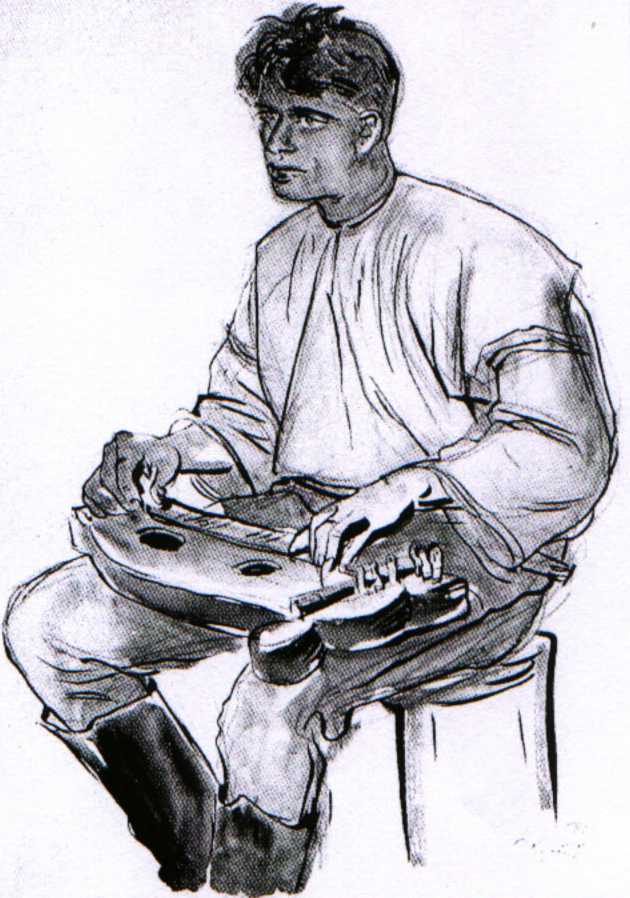
Kobza Player – "kobzáň", ink, pen and watercolor on paper, 1929
Jan Kobzan (1901 – 1959)
Around 1650 to 1750, the prismatic shape of the body was shortened and widened with an s-shaped bulge (which is why these zithers were called "belly zithers" in our country) and the fretboard strings began to be tuned to two tones (ad). Plucked zithers emerged, the representatives of which are the already mentioned Central European and Northwestern European zithers. A typical example is the so-called Hungarian zither, which is still produced and used today. Although its fretboard strings are tuned to one tone, the fretboard has two diatonic scales that complement each other on the chromatic scale. It is played like a kobza. These zithers are also built and used in southern and southeastern Slovakia. Of the preserved old products, one was signed by Ondrej Jergo Simunkin in 1800 (the exhibition features completely similar, but contemporary, instruments).
The transformation into the so-called plucked zither began to occur at the end of the 18th century. At that time, the use of picks began to cease and a metal ring-shaped thumb rest was introduced. The change consisted in the fact that the number of accompanying strings increased and the fretboard strings were also expanded by a third string, G. Plucked zithers were produced in two different forms, the so-called Salzburg type (older) and the Mittenwald type (younger, shaped like a guitar).
The oldest preserved and dated plucked zither is from 1773 and its author was Anton Rehrer. It is a type of Salzburg zither. A somewhat simpler product is known from Munich. It is from 1800 and its maker was Franz Kren.
The transition to the plucked style of playing was gradual and tortuous, as evidenced by numerous types preserved in the Museum of Czech Music in Prague. It is often difficult to determine whether the zither is a plucked or plucked type.
The oldest known Czech-made plucked zithers are those made by Antonín Mitáš (Mitteis) from Litoměřice (a student of Stauffer in Vienna) and Bernard Berkmajer (Bernhardt Berkemeyer) from Jihlava. Both instruments date from the early 19th century.
The plucked zithers of the early 19th century were still instruments of limited use. They were designed to be played in only three keys, the tuning of the accompanying strings was not yet systematic, and each player tuned them according to his own discretion. Such was the zither played by the famous Viennese virtuoso Johann Petzmayer (1803-1884). Since his time, the term zither (without an adjective) has come to mean exclusively a plucked string instrument with a double playing field (fingerboard and free strings), whose strings are arranged parallel to a flat, S-shaped body (unlike the harp, which has its strings perpendicular to the soundboard). Both hands are used to play.
It was only when Nicolas Weigel (1811-1878) introduced the chromatic fingerboard in 1838 (by then 4 fret strings were already in use) and used the quarto-quint tuning of the accompanying strings over the full range of 2 octaves that a decisive step was taken towards establishing a standard type of zither. The zither became an instrument that could be played in any key. And because Weigel also introduced a uniform notation in treble and bass clef, all this made possible the amazingly rapid expansion and popularity of the zither at the beginning of the second half of the 19th century.
Anton Kiendl became a world-famous manufacturer of zithers tuned and strung in this way, having founded a musical instrument factory in Vienna in 1843. The so-called concert zither was first produced in Munich in 1862 by Max Amberger (founded 1860).
The centers of zither production were Vienna and Munich, as other important zither manufacturers soon appeared there – in Vienna, for example, Ignatz Johann Bucher (founded 1816), later, for example, Michael Novy (later Franz Novy), Ludwig Reisinger (founded 1887), Karl Kiendl, the Kirchner brothers (founded 1871), Karl Kirchner (founded 1891). In Munich, the old manufacturers included Ignaz Simon, Georg Tiefenbrunner (founded 1842) – the maker of the first alto zither, Johann Haslwanter (founded 1852) – Simon's brother-in-law. Their equally important successors were Xaver Thumhardt, Igatz Roider (founded 1809), August Keller (founded 1892) and Hermann Hauser (founded 1908) – formerly Amberger.
Zither workshops were also established in other Austrian and German cities. For example, Neuner and Hornsteiner (founded in 1750) and A. Baader (founded in 1970) were known from Mittenwald. A famous manufacturer in Graz was Johann Jobst (founded in 1882), who first introduced a head resonance hole, in Passau it was Georg Heidegger and Johann Hornsteiner (founded in 1848), in Linz Eduard Heidegger (founded in 1870) – a large-scale manufacturer of zithers of the Huber system, in Regensburg Xaver Kerschensteiner (founded in 1832), in Stuttgart Robert Barth, in Steyer Engelbert Kaltenbacher, in Nuremberg the Gunzelmann brothers (founded in 1840) – manufacturers of zithers with a metal frame.
Workshops for zither makers of today's standard type naturally emerged in Bohemia, Thuringia and Saxony at the beginning of the second half of the 19th century. One of the most important areas for zither production was the southern foothills of the Ore Mountains. It is an area with a great tradition of musical instrument production. The main center on the German side of the Ore Mountains was and still is Markneukirchen. Products from masters such as Adolf Meinel (founded 1861) - today Adolf Meinel Jr. with his daughter Ulrika or Oskar Voigt (founded 1865) - later Kurt and Günter Voigt are considered some of the best. Among many others, we can mention at least Emil Schuster (founded 1865) - later Wilhelm O. Schuster, Ernest R. Glier and the current continuer of the tradition Horst Wünsche.
Currently, the most progressive manufacturer is Ernst Volkman (a native of Luhy), who introduced the production of highly sought-after zithers in Ingolstadt, whose body is based on the shape of a medieval psaltery, i.e. the so-called psaltery zithers.
It is also necessary to mention the so-called fretless zithers, which later, precisely on the basis of the popularity of standard zithers, also developed into many variants (the so-called chord zithers). Although chord zithers are a melodious instrument, they are not very functional. The impossibility of modulating tones and choosing any key predetermines them for use by young people. Also, fretted string zithers, the design of which is attributed to Johann Petzmayer (b. 1823 – the so-called heart type), remained on the fringes of interest.
Zither production in Bohemia
We do not have reliable documents about the beginnings of zither production in Bohemia. However, it is likely that the various types of zithers that were used in our countries also had their manufacturers here. An indirect reason for such an assumption is the historical fact that the lands of the Bohemian Crown have attracted a number of excellent craftsmen since the time of the last Přemyslids. The wealth of Bohemia, its important position in Europe and the fact that Prague was also the seat of the empire in the times of the Luxembourgs and the first Habsburgs, these are natural reasons for the development of not only interpretative but also instrumental musical art.
A concrete document of the form of medieval zithers used in our country is, for example, leaf no. 18 in the passional of abbess Kunhuta from 1320, which depicts the forms of a harp, a Bohemian wing, a fiddle and a cetera. The zither type is not only the centera of that time, but also the Bohemian wing (known in Europe at that time under the name ala bohemica).
The meticulous historian Zikmund Winter documents the names of some zither players from the 15th century in Prague, namely Václav Motýl in the Old Town of Prague (in 1456), another directly on the Old Town Square (in 1463), and finally the zither player Mikuláš in the New Town of Prague (in 1478).
From the turn of the 18th and 19th centuries, the aforementioned Antonín Mitteis in Litoměřice and Bernhard Berkemeger in Jihlava (a maker of pianos and all stringed instruments) are known for their zither products. In one private collection, a zither of an unknown Czech manufacturer is preserved, dated May 4, 1804. It is richly carved. In the second half of the 19th century, the violin maker and zither maker Josef Rudolf Lenhardt was known in Litoměřice. Hans Haubner was an important manufacturer in Mariánské Lázně. He produced very high-quality harp zithers of a specific shape and design, which, however, did not find a successor.
The most important area of zither production in our country, however, was the area of the Czech side of the southern foothills of the Ore Mountains, especially the towns of Luby, Plesná and Kraslice. These towns were already known for their traditional production of stringed and wind instruments a hundred years ago.
The production of zithers in the Lublin region cannot be separated from the production of other instruments. Lublin is famous primarily for the production of violins. It is assumed that the first manufacturers of musical instruments settled here in the second half of the 16th century. The oldest preserved instrument of Lublin provenance is a viola by Johann Adam Pöpel from 1664. In the 18th century, the violin maker Eliáš Placht (born around 1690) is documented, who is considered the founder of the Placht violin-making family dynasty. They were responsible for the permanent modern development of violin making in Lublin. Other important violin-making families were the Sandner, Hoyer and Schuster families (all of these names can also be found as zither manufacturers).
Until the end of the 18th century, the division of labor in the production of stringed instruments was almost unknown and masters made their instruments completely. At the beginning of the 19th century, the Luby guild of violin makers had around 55 masters. In the middle of the 19th century, however, due to demand, the production of musical instruments in Luby took on an industrial character. Specialization and division of labor created a number of independent professions. This led to the emergence of larger workshops with a narrowly specialized production program. Larger manufacturers arranged production from small subcontractors. The annual production of violins, cellos and double basses in the Luby region was enormous for that time and amounted to approximately 100 to 150 thousand pieces. The scale of production exceeded the German centers of Mittenwald and Markneukirchen, but the shift to quantity meant a retreat from quality.
Zithers in the Lublin region reportedly began to be produced around 1840. However, the first documented manufacturers were the violin makers Anton Schäffer (born 1834, trained in Znojmo, died in 1896) and Martin Stingl (trained in Vienna, produced in the years 1860-1890).
Around 1870, approximately 100 zithers were produced in the Lublin region per week, i.e. 5,000 per year. In 1897, the production of approximately 7,000 zithers per year is reported (the association lists 14 zither manufacturers). Perhaps the most reliable data is from 1905, when the annual production of 3,000 zithers is documented. For comparison, let us state that at that time the annual production of guitars in the Lublin region was 2,000 and mandolins 1,000. The lists for that time list 12 master zither manufacturers, 12 assistants and 1 apprentice (these manufacturers were: Josef Deistler, Josef Fuchs, Josef Goth, Josef Habermann, Johann Hannabach, the sons of JF Hoyer, Richard Künzl, Karel Loos, Anton Petzl, Johann Raab, Franz Siebenhünner and Hermann Trapp). However, due to the mentioned production method, the majority of craftsmen working in the production of musical instruments participated in the mentioned production numbers to a greater or lesser extent.
Anton Bräuer became the most important zither manufacturer not only in Luby, but in the whole of Bohemia. His instruments, with their quality of workmanship and sound, rank among the instruments from the most famous manufacturers. He founded the workshop in 1896 and around 1920 his factory employed up to 30 workers. It was not only the best, but also the largest specialized zither production. In the 1920s, this company offered 9 models in 46 designs (from the cheap Euphonia type to the top-of-the-range Perfekta types – harp concert zithers with crossed double bass strings).
Other well-known zither manufacturers in Luby were Johann and Václav Hannabach (founded 1872), Adolf Osmanek – stringer (founded 1850), František Boček (the first Czech violin maker and merchant in Luby), Josef, Rudolf and František Siebenhünner (founded 1892) – known for the Triumph type with a double resonant bottom, Hermann Trapp (founded 1878), Vincenc Müller (founded 1873) – known for the Apollo type with a double resonant bottom.
As late as 1924, the following zither manufacturers were listed in Luby: Anton Bräuer, Václav Hannabach, Franz Hirsch (founded 1911), Josef Siebenhünner, Hugo Wettinger (founded 1911), Johan Ludwig Buchner (founded 1890-30 workers) and Hermann Trapp (60-80 workers).
Manufacturers from Kraslice are represented in particular by Anton Hüller, Wilhem Riedl, Josef Seidl (founded 1856), Josef Michl and Adolf Vogl (founded 1883).
Manufacturers from Plesná are represented by: Adolf Barth, Reinhold Geipel (founded 1863) – later Reinhold Geipel's sons became known as the Sonora type, Karl Stübiger (founded 1892), Adolf Paesold (later Flügelnell), etc. A specific zither manufacturer was Jan Haubner in Mariánské Lázně. His instruments had a complex body shape.
Outside the Ore Mountains, zither production was significant in Prague. These were mainly manufacturers: Josef Wolf (the first and oldest musical instrument factory with a steam saw – founded in 1821), the Šámal brothers (later Karel Šámal – founded in 1835) – the Viennese Kirchner brothers’ firm was represented in Prague, Karel Votava, František Meyer, Václav Langmajer (founded in 1899), Josef Vojta and Jiří Hradecký (founded in 1901). In Děčín, these were, for example, manufacturers František Breite and Leo Schmidt.
As already mentioned, zithers were often made and sold by many violin makers. From outside the Ore Mountains, this was especially the case with František Ladislav Prokop (1843-1913), who came from an old violin-making family in Chrudim. His Czech musical instrument workshop was founded in 1820. FL Prokop supplied a wide range of zither types. Around the turn of the century, he also supplied top-of-the-line harp zithers with a guitar body and tailpiece – the Arion type. Products from the Prokop company are the most numerous in our country, along with zithers from the Bräuer company.
Other well-known suppliers of zithers among violin makers were Josef Kliment (1830-1914) in Brno, Ferdinand Lantner (1833-1906) – founded in 1862, and his son Bohuslav (1862-1917) in Prague, Benjamin Patočka (1864-1931) in Jičín (founded in 1888), Bohuslav Boček (1874-1949) in Prague in Smíchov (he trained in Vienna with Václav Fischer, worked first with František Hovorka in Vienna, then with his brother in Luby and became independent in 1905), Alois Bittner (1880-1950) in Kladno (became independent in 1909, previously worked with Jindřich Zazvonil), Jiří Krywalski in Cěšín and others.
The popularity of zithers was so great that the demand for them could only be met with the help of many anonymous body manufacturers. Well-known manufacturers (often not even making zithers) and suppliers of musical instruments therefore ordered their types from subcontractors and then guaranteed the quality of workmanship with their company label. This is a very common case in the Lublin region, for example, Jan Bašta, the Placht brothers, etc. In Kraslice, these were for example Wilhelm Riedl, Emanuel Hüller, Josef Michl and son, etc. In Plesná, Karl Stübiger or Richard Schuster, in Oloví, for example, the firm Richard Gareis and in Krajková, Anton Schrotter. In Brno, the well-known company Josef Lídl employed around two zither manufacturers (or master violin makers) from the Lublin region, and in Pilsen, Stanislav Brázda (founded in 1906) was an important supplier of zithers.
In addition, there were a number of domestic manufacturers who sold their products either directly to customers or through door-to-door salesmen, i.e. resellers. Given the mass production of musical instruments, as was practiced in the Lublin region, it is not surprising that this was a frequent case. Zither production was also a common form of income in the winter in remote mountain areas. The zithers in question, of course, have neither a company label nor a manufacturer's mark and their quality is highly variable (quality of the material).
If we proceed from the production numbers mentioned and take into account the production period of individual companies, we can very soberly estimate the number of zithers produced in our country at 150 to 250 thousand pieces. The results of a statistical survey of a sample of 200 zithers show how widespread each type is in our country. 90% of the preserved zithers in Czechoslovakia are of the standard type and the other 10% are so-called chord zithers (these were only produced to a limited extent in Bohemia). Of the standard zithers, 40% are marked by domestic manufacturers or distributors and 45% are unmarked (they can mostly be considered to be of domestic origin). The remaining 15% are products of foreign companies, mainly from Austrian masters Kiendl, Heidegger, Kirchner and Jobst.
Playing the zither in Bohemia
The first written mention of playing the zither (in the broader sense of the word) dates back to the 12th century (Vincentius). Starting from the second half of the 14th century, there are numerous references to playing the zither (kobza) in old Czech literature. Records from the 16th century indicate that kobza (or koboza) were folk instruments. Until the 18th century, playing the zither was practiced mainly in mountainous and foothill areas. There, its character best suited the musical use of the inhabitants of these remote and sparsely populated areas.
One of the Czech zither players of the last century was František Dvořák (1814-1894), the father of the composer Antonín Dvořák. It is known that he neglected his trade for the sake of the zither. He would go to pubs in the Kladno region with his zither and also taught zither playing. The zither was a family instrument for the Dvořáks – other members also played it.
Karel Cibula (1865-1926) was particularly responsible for the development of Czech zither music. Both brothers became the founders of Czech zither music. They came from a mining family from Buštěhrad. It was perhaps the influence of František Dvořák, who enchanted them with his playing in childhood so much that they dedicated their entire lives to playing the zither. Karel Cibula graduated from the Czech Polytechnic Institute and then worked as an engineer at the Prague City Hall. František Cibula graduated from the Prague Teachers' Institute and as a teacher, later director, he worked in several schools in the Kladno region (Dřínov, Mšecké Žehrovice, Stochov, Řevničov, Srby). Together with others, they independently and together with others, established several Czech zither schools, composed many pieces for the zither and published even more transcriptions.
At the end of the second half of the 19th century, the cultivation of zither playing began to be associated with club social activities. Since the boom of zither music making falls within the period of upheaval of Czech society in the struggle for national independence, it is not surprising that, just as zither clubs were established in Vienna, for example, they also began to be established in Bohemia and especially in Prague. Czech zither clubs were a manifestation of national consciousness and national traditions.
The first Czech zither club was founded in Prague in 1875. After 1886, clubs began to emerge in all the peripheral cities (today districts) of Prague and in many other Czech cities. The following incomplete overview testifies to this:
The first Prague zither club – founded in 1875
Musical Association of Zither Players in Jindř. Hradec – 1878
Zither Club in Prague – Holešovice – 1886
Zither Club in Smíchov – 1888
The first zither club in Karlín (later the Cither and Tamburitza Club in Prague) – 1889
Zither Club in Král. Vinohrady – 1889
Zither Club in Vršovice – 1891
Czech Zither Players Club in Prague VII – 1891
The first zither club in Žižkov – 1893
The first zither club in Pilsen – 1894
The first zither club in Slaný – 1894
The first zither club in Nový Strašecí – 1894
The Cither Club in Kladno – 1896
Zither Club in Turnov – 1896
Educational club of zither players in Brno – 1899-1903
Zither and Mandolin Club in Prague-Liben – 1902
Zither and Mandolin Club Prague-Letná – 1903
Zither Club in Mladá Boleslav – 1903
1st Club of Czech Zither and Mandolin Players in Brno – 1907
Club life took place in rented restaurant halls at regular meetings. Classes were systematically held in the clubs and joint playing was cultivated. Numerous performances were organized, for which printed programs were published. Classical music and adapted folk songs were played at concerts and parties, and popular opera and operetta compositions by contemporary Czech and foreign composers were popularly performed. Compositions by Karel or František Cibula were almost never missing from the programs. Both were so recognized that almost every Czech zither club awarded them an honorary mention.
Statistical development of the structure of the concert repertoire of Prague zither clubs at the beginning of the 20th century
In 1891, the professional magazine "Český citerista" began to be published in Prague. It was the organ of all Czech citer clubs and was published monthly. From 1894 it was called "Časopis českých citeristů" and from 1908 "Věstník českých citeristů". Its publication ended at the beginning of the First World War and its publication was not resumed after the war.
Among the followers of the Cibul brothers, we should mention at least the composers Josef Formánek (1844 to 1926), Josef Novák, Eduard Pavel (1856-1909) and especially the prematurely deceased Jan Bernhardt (1869-1914). The composers Julius Neukirchner and Eduard Süss were active in the Ore Mountains before the war. Even today, there are composers in our country who write for the zither (e.g. František Malíř and Michal Müller). But that is already the present, which is written about in the introduction to this text.
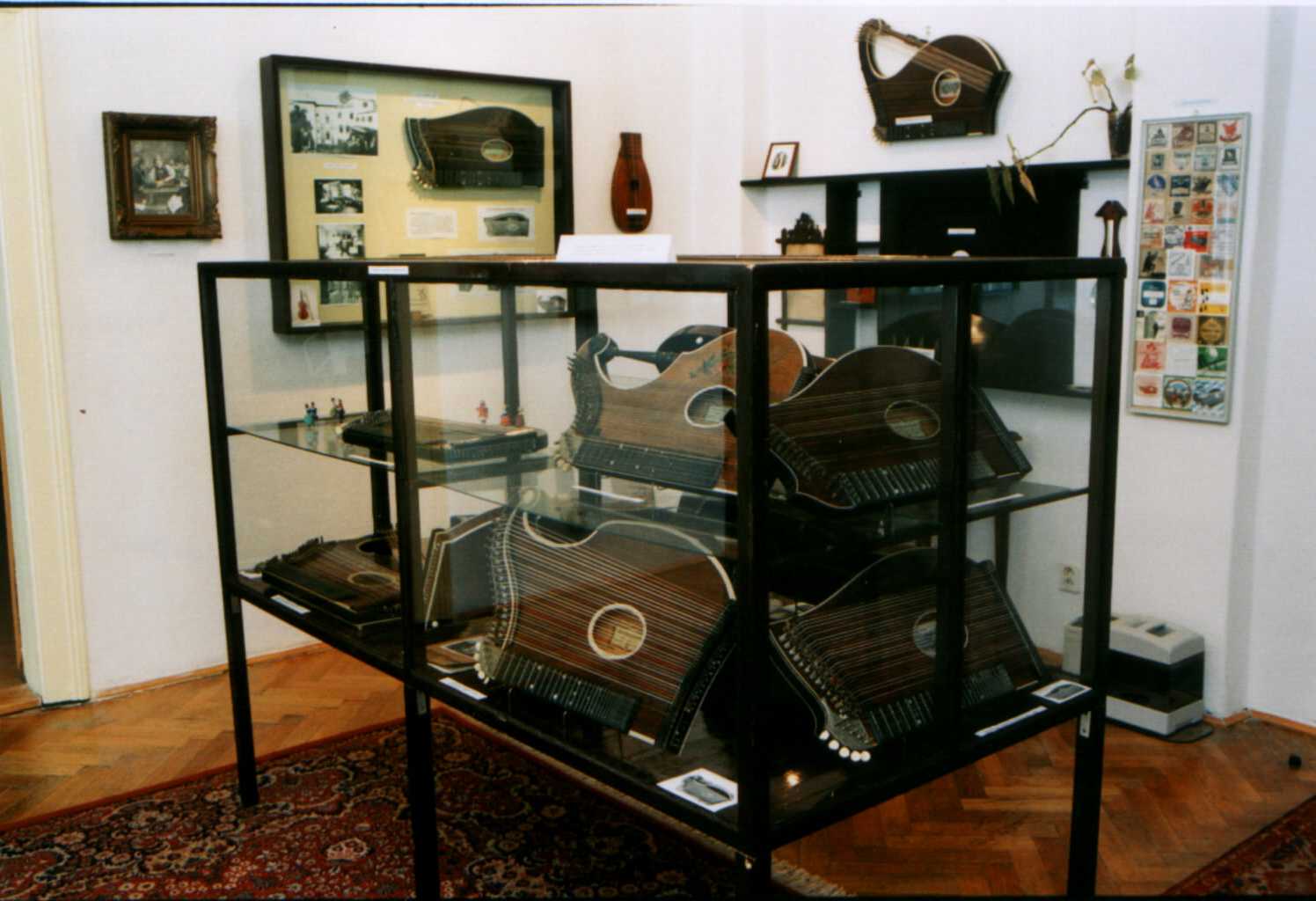
From the exhibition "The Zither in Bohemia, Moravia and Silesia" at the CITERÁRIUM museum
(Masarykovo náměstí 20, Ostrava 1), photo D. Ramík
Literature:
Brandlmeier Josef: Handbuch der Zither I., II., München 1963, 1979.
Boháč Jaromír: Z dějin výroby hudebních nástrojů na Lubsku, 1982.
Pilař Vladimír, Šrámek František: Umění houslařů, Panton 1986.
Engl Rafael: Öesterreichs Cremona
Industrie Compas: Finanzielles Jahrbuch, 1924, Wien
Kunz Ludvík: Dvě historické vrstvy pražcových citer, sborník II. setkání citeristů, Příbram 1986
Buchner Alexandr: Hudební nástroje národů, Artia 1969
Kunz Ludvík: Kobza – příspěvek k výzkumu lidových hudebních nástrojů, zvl. otisk z časopisu Československá etnografie I., 1953
Kunz Ludvík: Die Volksmusikinstrumente der Tschechoslowakei, Teil I., Handbuch der
Europäischen Volksmusikinstrumente, Leipzig 1974
Elschek Oskár: Die Volksmusikinstrumente der Tschechoslowakei, Teil II., Handbuch der Eurpäischen Volksmusikinstrumente, Leipzig 1974
Květ j. M.: Mládí Antonína Dvořáka, Světový literární klub v Praze, 1943
Wit Paul: Weltadressbuch gesamten Musikinstrumenten – Industrie, Leipzig 1897, 1925/6
Nejedlý Zdeněk: Dějiny předhusitského zpěvu v Čechách, Praha 1904
Folprecht Jan: Několik rad začínajícím citeristům, OKS Příbram, 1987, resp. Ostrava 2002.
Folprecht Jan: Citera v Čechách, na Moravě a ve Slezsku – Zither in Böhmen, Mähren und Schlezien, Praha 1995.


