Catalogue of the Citeraria depository or 555 zithers
Jan Folprecht, Ostrava 2014
Introduction
The collection of zithers presented in this catalogue was created from approximately 1985 to the present, i.e. until 2013. From the very beginning, the collection was conceived thematically, focusing on instruments made in the Czech lands. But it is understandable that when I had the opportunity to acquire an interesting foreign zither, I could not resist it.
There were, of course, many stimuli that eventually led to the creation of a relatively extensive collection of zithers. The first was definitely when I read on a poster in the autumn of 1985 that a Meeting of Czech Zither Players was taking place in Příbram. Until then, I thought, like most of our public, that zithers were some ancient musical instruments that no one has played for a long time. I already attended the second year and realized that the opposite was true. The zither is said to have a captivating tone, which in my case was indeed the case, and I was so captivated and enchanted by it that from that moment on I began to take a relatively systematic interest in this area.
The decisive impetus was when the deputy director of the Cheb Museum, Dr. Boháč, approached me and offered me the opportunity to organize an exhibition of zithers in the local city museum. That was in the summer of 1987. I had no idea what it entailed, I only had about ten of them at home at the time, but the offer intrigued me and I agreed. And how did we meet? It was about a year earlier. I started to travel to the Ore Mountains relatively often, because my employer had a company cottage near Kraslice, and I therefore had a suitable base for searching for zither manufacturers from the Ore Mountains. Dr. Boháč stayed on the "Flussberk", which is a slope above the Luby River, or rather the former Schönbach, and as a native of the region and an expert on the history of this region, he was one of my advisors on where to go to find the remains of the local tradition of zither production and the last local zither "Mohycans".
The main question was how to get zithers for the exhibition. I could probably borrow some from my fellow zither players. But that would not be enough. In Prague, where I was born and worked in a research institute after my studies, there were two musical instrument bazaars during the totalitarian period, where you could always find a few zithers, as they complemented the diverse assortment. They were not expensive – after all, the supply completely exceeded the demand, which was practically zero. Only foreign visitors took advantage of this, because they could buy such a souvenir there, extremely cheaply for them. However, that would not be enough for my purposes either. Things took off when I placed an advertisement in the newspaper. My laconic and easily overlooked message: “I collect zithers” received over 240 offers. Every weekend I started touring the Czech Republic with my family and getting to know the strange shapes and designs of these instruments. What I didn't buy, I at least photographed and repainted at home. I also visited the Czech Museum of Music, where I gradually studied the entire depository with many very old and interesting zithers. All of this was the only possible way, because there was practically no other way to get acquainted with zithers and their past. There was no professional Czech literature on zithers at all, and the few mentions in books on general organology were more than scant (and I'm not talking about the reliability of information related to zithers). So I slowly began to orient myself in the world of zithers, and at home I slowly began to accumulate an interesting and actually unique collection of zithers, which testified (by their design and their frequency of manufacturers) to the very rich history of zither production and use in the Czech lands from the beginning of the 19th century until the Second World War. The first information about the existence and life of Czech zither clubs was provided to me by several bound volumes of the "Journal of Czech Zither Players" from the end of the nineteenth century, which were preserved by a Prague zither player.
And so in the summer of 1987, the exhibition "Zither in Bohemia" (the first of its kind in our country) was indeed opened in the Cheb Museum, and it certainly fulfilled even more than I expected from it. The famous zither maker from Markneukirchen, Mr. Adolf Meinel, after viewing my exhibition, wrote these words in the guest book: "The exhibition convincingly demonstrates the independent and continuous development of zithers in the Czech lands." And he added: I live and have been making zithers for the fourth generation, just a short distance from here, in Markneukirchen, and I had no idea until then what wonderful and interesting instruments were being made here in Schönbach ." These were words that described and confirmed the meaning of my efforts, and from that moment on, I began to believe that the goal of the exhibition had been achieved.
But how was it possible that the continuous tradition of zither production in Bohemia that I had uncovered, and especially the scope and quality of production in the Schönbach area, remained completely unnoticed for so long? The reason is the specific Czech socio-national development throughout the twentieth century. After the First World War, the Czech ethnic group, in the affect of the gained national independence, completely turned away from the aforementioned tradition (as well as from everything that reminded them of Austria and Vienna). This was of course no reason for the German ethnic group in the border region, which, however, after the Second World War resulted in the zithers becoming a symbol of the “Sudeten German betrayal” and all the hardships that wartime fascism and Nazism brought to us. This was how the Czech ethnic group finally dealt with zithers. This opinion was then fed by all professional literature for over fifty years. The untruths and half-truths in those few organological books are a mirror of the socio-national climate that has been convulsing Europe throughout the twentieth century, and are therefore strongly rooted in our society.
I organized another exhibition in 1996 in Havířov and the following year in Frýdek-Místek. That was when I moved from Prague to Ostrava, and both cities are actually part of the Ostrava agglomeration. The exhibition was called "The Zither, My Instrument" and was essentially as extensive (about 80 instruments) as the one in Cheb.
A worthy conclusion to these activities was a large exhibition in Prague's Hradčany (in the Lobkowicki Palace), which was held in the autumn of 1987 under the title "Zither in Bohemia, Moravia and Silesia". Thanks to the location in our capital city of a hundred towers, the exhibition had a very large number of foreign visitors and a generally positive response.
The autumn of 2002 marked the completion of the previous activities in this area, as I opened a permanent public exhibition of zithers under the almost identical title: "Zithers in Bohemia, Moravia and Silesia" in the very centre of Ostrava - on Masaryk Square (in the premises called Citerárium). The over 140 zithers exhibited since then convincingly demonstrate, together with visual and textual material, the aforementioned richness of the history of zithers in our countries. In the following years, the project found recognition and support from the city and the region, and thus it was possible to successfully continue all the activities set out (unfortunately, this does not apply to the current situation).
The result of my collecting activities was the publication of the monograph "Zithers in Bohemia, Moravia and Silesia", which was published in Czech in 2005 and in German in 2010. All my findings are summarized here, which can be viewed in physical form in the aforementioned Citerárium exhibition.
Many other zithers, however, remain locked in their cases in the Citerárium depository. That is why I decided to publish this catalogue to acquaint not only the relatively small group of European zither players, but also all others, even casual ones, with the complete content and scope of my collecting efforts. I do not consider myself a collector, in fact I have an aversion to the term, because I am against collecting something just to have as much of it as possible. I think that the above-mentioned monograph, which I was able to write precisely thanks to collecting those silent witnesses of the past and being able to make them speak, is evidence of my fundamentally different approach.
In Ostrava on February 15, 2013 Jan Folprecht
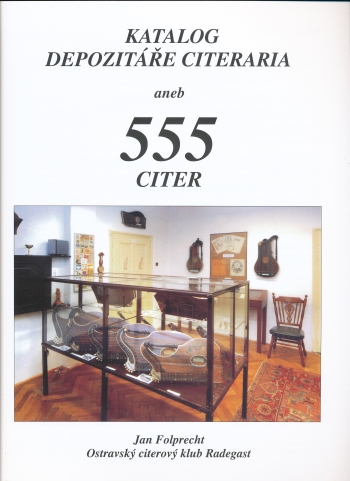
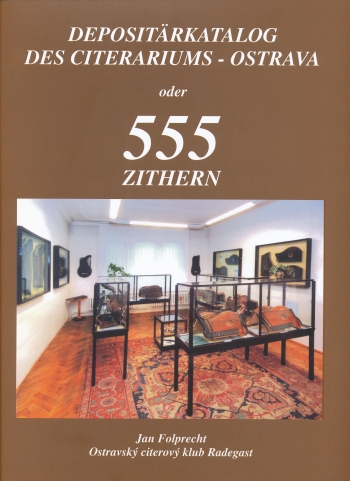
Author: Jan Folprecht
Catalogue of the Citeraria depository or 555 zithers
Publisher: Ostrava Zither Club Radegast, Ostrava 2014


